What is hyprmoncfg?
The problem with Hyprland monitor configuration
Configuring monitors in Hyprland means writing monitor= lines by hand. You guess at coordinates, reload, realize they’re wrong, edit again. There’s no visual feedback until after you’ve committed to a config.
Then it gets worse. You unplug your laptop, go to a conference, plug into a projector – and you’re back to editing config files backstage before your talk. You come home, dock the laptop, and the layout is wrong again because DP-1 and DP-2 swapped since last boot.
Existing tools try to help but bring their own baggage: Python runtimes, GTK dependencies, fragile hotplug behavior. Some only do visual arrangement with no profiles. Others do profiles but have no editor. None of them verify that Hyprland is actually reading the file they’re writing.
What hyprmoncfg does differently
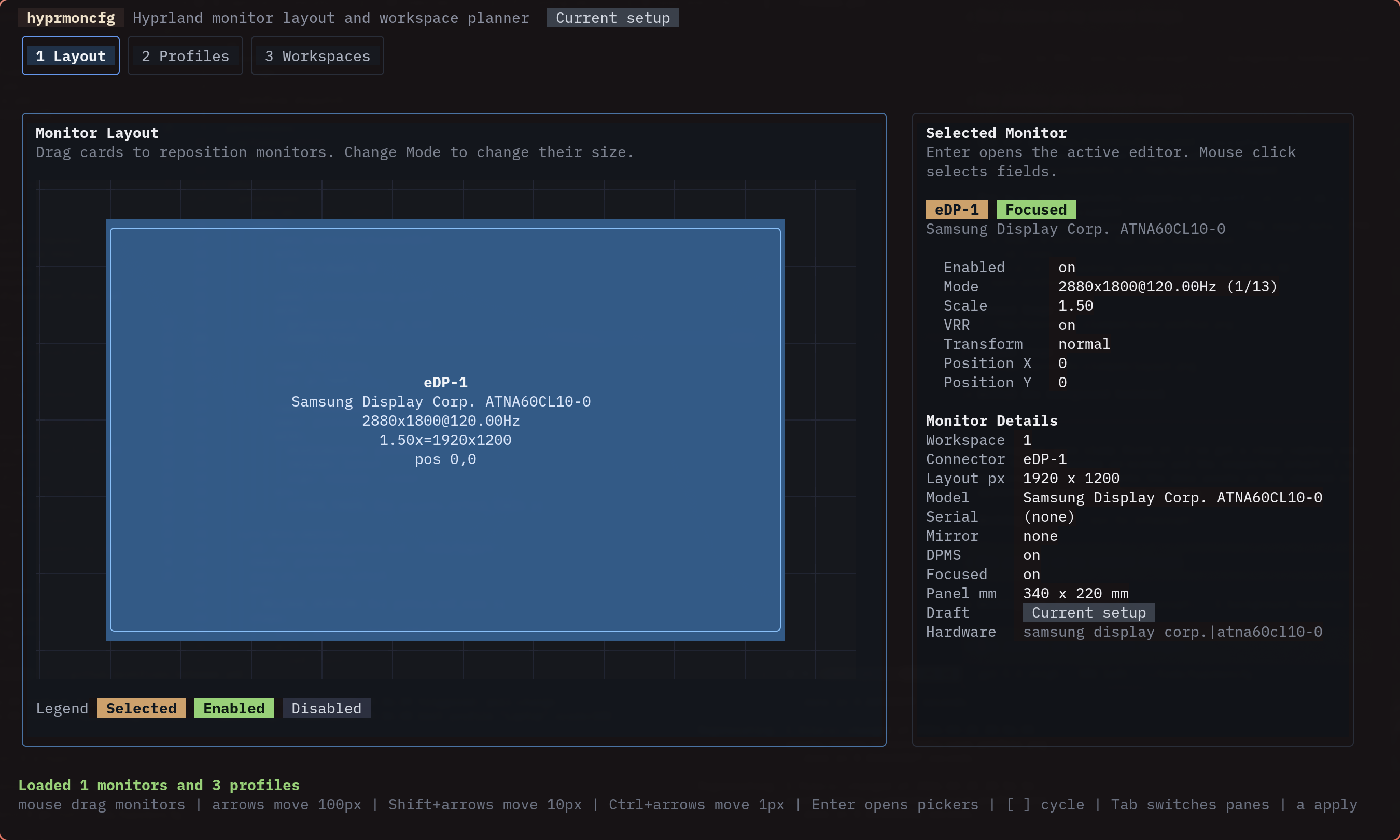
It’s terminal-first, not terminal-only. The TUI has a real layout canvas with drag-and-drop, a per-monitor inspector, picker dialogs, and a workspace planner. It’s not a glorified config editor – it’s a spatial tool that happens to run in your terminal.
One apply engine, everywhere. The TUI and the daemon use the exact same code path: write monitors.conf atomically, reload Hyprland, re-read monitor state, verify. No “best effort” daemon behavior. No silent failures.
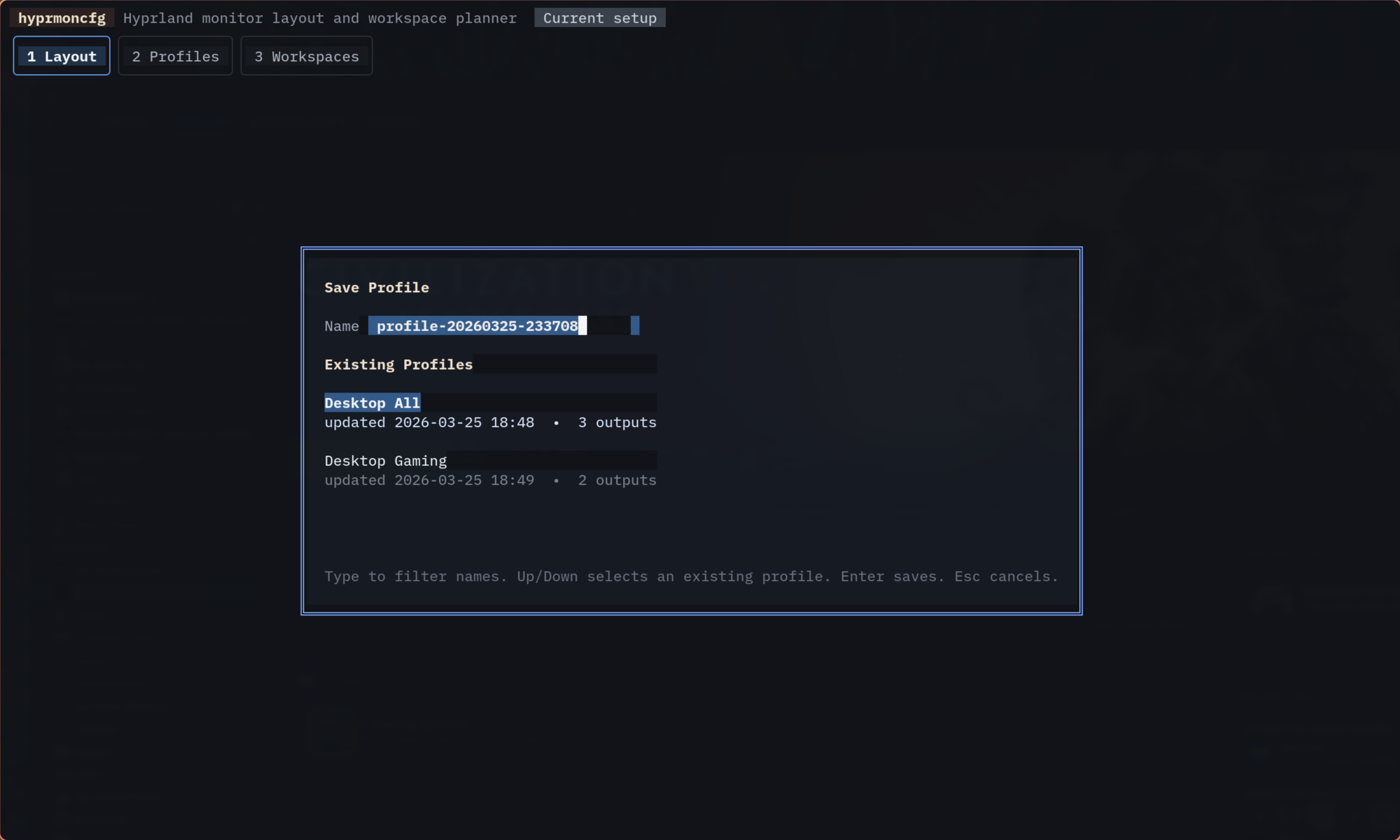
Profiles follow your hardware, not your ports. Each profile stores monitor identity by make, model, and serial – not by connector name. DP-1 and DP-2 can swap all they want. Your layout holds.
It verifies the source chain. Before writing anything, hyprmoncfg checks that hyprland.conf actually sources the target monitors.conf. Other tools skip this and silently update files that Hyprland never reads.
Zero runtime dependencies. Two compiled Go binaries. No Python, no GTK, no GObject introspection, no D-Bus. Install them and you’re done. They even work over SSH.
How it compares
| hyprmoncfg | Monique | HyprDynamicMonitors | HyprMon | nwg-displays | kanshi | |
|---|---|---|---|---|---|---|
| Spatial layout editor | Yes | Yes (GTK4) | Partial (TUI) | Yes | Yes (GTK3) | No |
| Drag-and-drop | Yes | Yes | No | Yes | Yes | No |
| Snapping | Yes | Not documented | No | Yes | Yes | No |
| Profiles | Yes | Yes | Yes | Yes | No | Yes |
| Auto-switching daemon | Yes | Yes | Yes | No (roadmap) | No | Yes |
| Workspace planning | Yes | Yes | No | No | Basic | No |
| Safe apply with revert | Yes | Yes | No | Partial (manual rollback) | No | No |
| Source-chain verification | Yes | No | No | No | No | No |
| Works over SSH | Yes | No | No | No | No | N/A |
| Runtime dependencies | None | Python + GTK4 + libadwaita | UPower, D-Bus | None | Python + GTK3 | None |