Omarchy Quattro Panel
Displays, handled
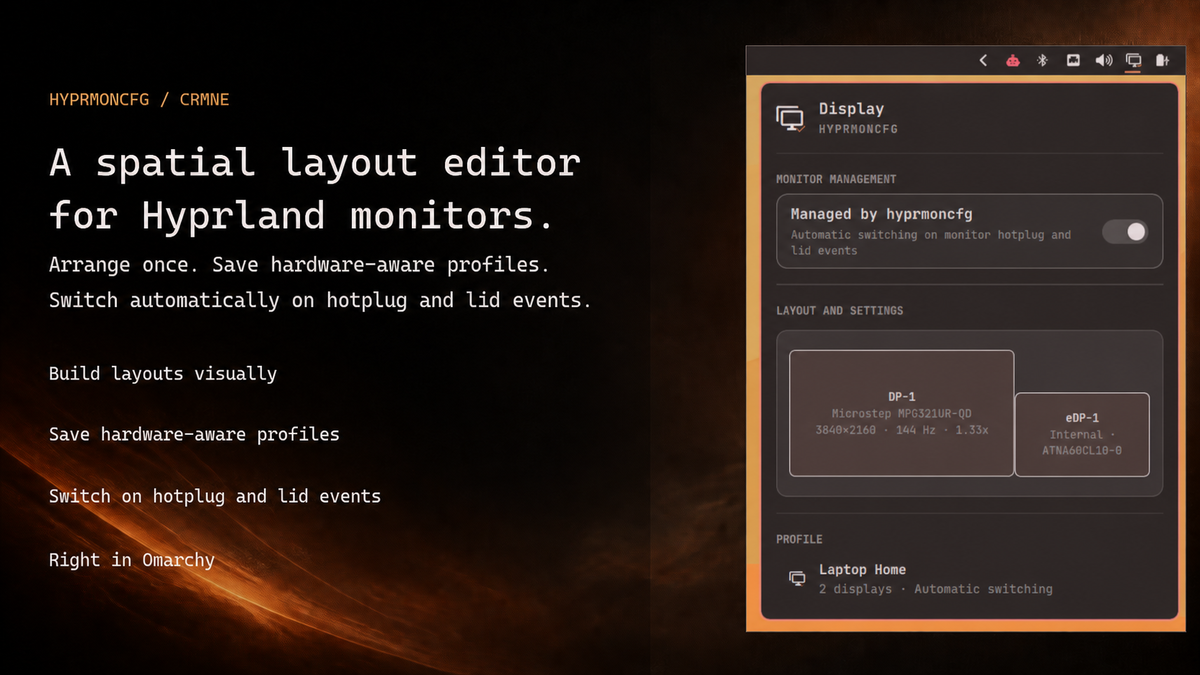
The hyprmoncfg: Multi-Monitor Manager for Omarchy plugin is a native graphical panel for Omarchy Quattro. Arrange displays visually, plan workspaces, and save hardware-aware profiles that switch automatically on hotplug and lid events. Open it from the bar to see the live layout, the matching profile, and whether hyprmoncfg is managing your displays.
hyprmoncfg is a separate project from HyprMon, the terminal monitor tool linked in Omarchy’s manual.
If you find the panel useful, I’d appreciate a star on GitHub. It helps get the word out.
Choose Expand to open the graphical editor inside the panel. Its Layout, Workspaces, and Profiles pages let you configure the setup without opening a terminal. The optional TUI button opens the companion terminal editor, which is also useful from a TTY or over SSH when you need to work on a running Hyprland session without its graphical panel.
Turn management on and hyprmoncfg switches profiles automatically on monitor hotplug and laptop lid events. Turn it off to hand display management back to Omarchy. Monitor ownership and workspace ownership are separate; see the compatibility notes below.
Install the panel
Get it from the Omarchy Plugins marketplace, or install it directly:
omarchy plugin add https://github.com/crmne/omarchy-hyprmoncfg.git --enable
If hyprmoncfg is already installed, the panel connects to its daemon over the local IPC socket and updates as monitor state changes.
If it is missing, open the panel and choose Install hyprmoncfg. The panel uses Omarchy’s normal presented package flow to install the stable AUR package and enables and starts hyprmoncfgd.service. The current installer opens the companion TUI after installation. You can use it for initial setup or return to the panel and choose Expand to arrange and save your first layout graphically. The panel refreshes as soon as the daemon is ready.
What the panel controls
- Managed by hyprmoncfg enables or disables the user daemon
- Expand opens the native graphical editor
- Layout provides drag-and-drop arrangement with snapping, resolution, refresh rate, scale, rotation, mirroring, and colour settings
- Workspaces provides manual, sequential, or interleaved plans, plus Off to leave workspace rules to another manager
- Profiles manages saved arrangements and automatic selection
- Preview & save lets you try a layout before confirming and saving it; unconfirmed changes revert automatically after the preview deadline
- TUI opens the optional terminal editor
The panel is a desktop surface for the same daemon and IPC protocol used by the TUI and CLI. It does not maintain another copy of monitor state or write Hyprland configuration on its own.
When Omarchy still moves your displays
Omarchy also changes monitor state from its watcher, clamshell, startup, and wake paths. These can conflict with another monitor manager. hyprmoncfg includes automatic compatibility measures:
- hyprmoncfg writes its own
~/.config/hypr/hyprmoncfg-monitors.luaand adds one line at the end ofhyprland.luato load it. This gives its generated rules precedence over earlier configuration during a reload. Scripts that send later monitor commands can still change the live layout - the daemon stops Omarchy’s monitor watcher while it owns your displays
- each apply shares the internal panel’s position and scale through a marked block at the start of an existing
monitors.lua, because Omarchy’s clamshell script reads that file rather than following generated includes. The rest of your file is preserved, and the block is removed when management is handed back. The scale is also recorded in Omarchy’s state file
The daemon also shares Omarchy’s native Laptop Display toggle. When a profile disables the internal display while an external display is active, it records that choice in Omarchy’s manual-disable flag before reloading. Omarchy’s wake and clamshell paths already respect this flag, so they leave the disabled panel alone instead of repeatedly enabling it on the lock screen.
Changing Hardware → Laptop Display or its keybinding updates the active profile’s internal-display setting. The daemon uses the saved profile as its base, preserving the display’s position, scale, and mode when turning it back on. If an older external-only profile omits the laptop display entirely, enabling it adds the panel to the right of the existing layout, using its reported mode or an advertised mode when the disabled panel has no live geometry. The change is saved after a successful apply and keeps automatic profile selection in its current mode. A toggle can take up to the daemon’s polling and debounce interval to appear. Preview rollback restores the previous native flag as well as the generated configuration.
Flag changes during sleep, lid changes, and external-monitor reconnection are treated as recovery activity, not as edits to your saved profile.
This integration uses Omarchy’s existing user state; it does not modify packaged scripts or require the proposed monitor-management switch. The flag continues to reflect the last applied layout when management is handed back. Other tools can still send conflicting monitor commands directly, and future Omarchy changes may require adapting this integration.
Omarchy 4.5 per-monitor workspaces
Omarchy 4.5 release candidates introduce separate workspace slots 1 through 10 on each monitor. Number-key bindings and bar labels use those local slots, while Hyprland still uses global workspace IDs underneath. Omarchy also moves and renumbers workspaces to keep them in each monitor’s block.
This can conflict with a hyprmoncfg profile that assigns global workspaces across displays, such as 1–3 on one screen and 4–6 on another. The monitor compatibility measures in hyprmoncfg 1.25.1 and earlier do not disable Omarchy’s workspace manager. Loading workspace rules last is not sufficient to prevent later reconciliation from changing them.
If you want Omarchy to own workspace placement, choose Off for the profile’s workspace strategy. hyprmoncfg then writes no workspace rules for that profile and retains its saved plan for later use. This does not restore global number-key behaviour or undo workspace IDs Omarchy has already changed.
Keeping global workspace assignments requires Omarchy’s per-monitor behaviour to stand down as well. The proposed per-monitor workspace toggle is tracked upstream; it is not part of Omarchy 4.5.0rc2.
hyprmoncfg 1.26.0 and newer make an enabled workspace planner own global
numbering once its plan places a numbered workspace. A plan of only named or
special workspaces, such as special:qconsole, leaves Omarchy’s per-monitor
workspaces and shortcuts alone. The existing generated Lua file disables Omarchy’s workspace
reassignment and restores global shortcuts, without another include or changes
to packaged Omarchy files. This applies through the shared engine used by the
daemon, TUI and panel. Off continues to delegate workspace management.
Pair global mode with the optional Global Workspaces widget. It displays the real workspace IDs and highlights the globally focused workspace on every bar, matching Omarchy’s original widget. Omarchy’s stock RC2 widget still assumes per-monitor numbering. Switching ownership does not automatically move or renumber existing windows.
Check the configuration load order
Check the load order at any time:
hyprmoncfg doctor
If your Hyprland config is managed by a dotfile tool such as chezmoi or stow, keep the line hyprmoncfg doctor prints in your source copy. Otherwise your dotfile tool and hyprmoncfg will keep re-adding and removing it.
Remove it
omarchy plugin remove crmne.hyprmoncfg
Removing the panel leaves hyprmoncfg and your saved profiles installed. Turn off Managed by hyprmoncfg first if you also want Omarchy to resume display management.